Browsed by
Author: Publisher

BIRTHING YOUR BABY: the second stage of labour by Nadine Pilley Edwards

BIRTHING YOUR BABY: the second stage of labour by Nadine Pilley Edwards

BIRTHING YOUR BABY: the second stage of labour by NADINE EDWARDS
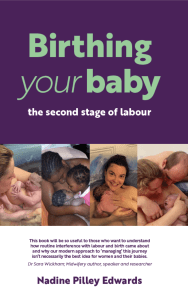

Birthing your baby: the second stage of labour by Nadine Pilley Edwards

Nadine Edwards’ latest book, published December 2019 is Birthing your baby: the second stage of labour.

Meeting her baby for the very first time, is usually one of the most powerful and magical experiences of a woman’s life. If surrounded by love, privacy and calmness, her body takes over and instinctively knows how to birth her baby, even if she hasn’t had a baby before. While obstetric expertise and technology are invaluable for the mothers and babies who need them, too often, routine practices and interventions can make it more difficult for women to birth their babies straight forwardly using their own strengths and instincts. This book describes physiological birthing, looks at current beliefs and practices around birthing, examines some of the relevant research and suggests how women can increase the likelihood of giving birth to their babies using their own efforts without unnecessary interventions.


Buy Online

Birthing your baby: the second stage of labour is available to purchase online both in paperback and eBook format from here: https://amzn.to/2x1X9x7


Dr Sara Wickham:

The journey of birth is one that has been undertaken by women and babies for millennia, and yet in the last couple of hundred years has been monitored, managed and manipulated because of the advent of the obstetric, medical, technocratic approach to birth.

Has that approach been beneficial? It depends on how you look at it.

Some lives have been saved, but others have been damaged, by over-intervention and from an approach that focuses on short-term physical outcomes and fails to look at the emotional and social aspects of birth, or at the wider, longer-term consequences of the interventions and technologies that are now almost routinely applied.

Many of us are looking at and challenging this area, from different angles and in relation to different aspects of the birth journey. Nadine Edwards’ latest offering – which I am delighted to have commented on while she was writing it – is an updated version of ‘Birthing your baby’; her popular book on the journey of birth itself. In it, she has applied her considerable knowledge and analytical skills to look at physiological birth and the different approaches to the birth journey. One of my favourite aspects of ‘Birthing your baby‘ is how Nadine shows that, unfortunately, there are many things that we cannot clearly know or see, because of the high-tech, standardised, hospital-based approach to birth that has taken root in many countries. It is my hope that her work on this will help more people see the importance of questioning what we are currently offering and consider whether a different approach might better serve us.

Birthing your baby‘ will be so useful to those who want to understand how routine interference with labour and birth came about and why our modern approach to ‘managing’ this journey isn’t necessarily the best idea for women and their babies. Even better, Nadine breaks down some of the different aspects of this journey, looking at the evidence and laying out the options for those who will need to make decisions about what they might want to put in place for their own birthing journey. I heartily recommend this book to anyone who wants to learn more about this area and consider the evidence from a woman-centred perspective.

Review at: ps://www.sarawickham.com/book-and-resource-reviews/birthing-your-baby/

Becky Reed

Nadine has thoroughly updated this excellent book, which could change the way we all look at birthing our babies. Every aspect of this often misunderstood phase of giving birth is explained and discussed, with exhaustive research quoted at every step of the way to support the information.

Since qualifying as a midwife over 30 years ago I have observed thousands of women birthing their babies. Strict timings, unnatural positions, unnecessary interventions, bright lights and noise have all become part of the modern birth scene for too many women. I hope that women and their birth supporters will read this book, which will help them to make the birth choices that are right for them. But I also hope that Birthing your Baby will become required reading for midwives and doctors, helping them to question their routine practices so that more women are able to give birth ‘instinctively and undisturbed’, and take forward a positive memory of bringing their baby into the world.

Review at: https://www.amazon.co.uk/Birthing-your-baby-second-labour/dp/1916060617

BIRTHING AUTONOMY Women’s Experiences Of Planning Home Births by NADINE EDWARDS

BIRTHING AUTONOMY Women’s Experiences Of Planning Home Births by NADINE EDWARDS

BIRTHING AUTONOMY: Women’s Experiences Of Planning Home Births by NADINE EDWARDS


Birthing Autonomy: Women's Experiences of Planning Home Births, Nadine Edwards
Birthing Autonomy: Women’s Experiences of Planning Home Births, Nadine Edwards

IN HER BOOK, Birthing Autonomy: Women’s Experiences of Planning Home Births, Nadine Edwards brings some balance to the difficult arguments that arise from debates about home births, and focuses on women’s views and their experiences of planning home births. It provides an in-depth exploration of how women make decisions about home births and what aspects matter most to them. Comparing how differently the pros and cons of home births are constructed and contemplated by mothers and by the medical profession, the book looks at how current obstetric thinking and practices can disempower and harm women emotionally and spiritually as well as physically.

Written in an accessible style, this book is enlightening for student and practicing midwives and obstetricians, as well as researchers and students of nursing, medical sociology, health studies, gender studies, feminist practitioners and theorists. It will also be invaluable to expectant mothers who want to be more informed about the choices they are facing and the wider context within which their birth options are considered.

Buy Online

Birthing Autonomy Women’s Experiences of Planning Home Births is avaliable to purchase online from the publisher’s website here: https://www.routledge.com/Birthing-Autonomy-Womens-Experiences-of-Planning-Home-Births/Edwards/p/book/9780415354097

Reviews

“It has taken me a long time to get round to reading this book and in the intervening time, the points that the author makes have become even more salient and the situation for birthing women even less rosy.

“This may look like a niche book. It isn’t. This is absolutely fundamental stuff. Edwards’ PhD study interviewed, in a very intelligent way, women planning, and having, or not having, babies born at home. And boy did she get some very intelligent, far from uniform, responses. The way she has written the book allows us to hear the women’s voices loud and clear, and then she has done the work to draw out the themes. Which may be surprising… Spoiler Alert: It’s not about geography. Her findings present both a challenge and an opportunity. One which midwifery is failing, big time currently (I say midwifery not ‘midwives’ for reasons that are made clear in the book and in other powerful works) Her work shows the impact not just in a narrow clinical sense, nor even just on parenting, but on women (and their partners) in much bigger ways. Get birth ‘right’ (by which I don’t mean ‘lucky’) and you might change the world. (She doesn’t quite say this but I do wonder if one of the forces in opposite isn’t an unconscious fear of the power of the empowered vs the (sadly usual) disempowerment)” – from: https://www.goodreads.com/book/show/2048954.Birthing_Autonomy?from_search=true

‘If you’ve felt disempowered by the birthing profession in your choice to home birth, you’ll no doubt find a great ally in this book’ – The Mother

PhD Thesis

Nadine’s book is based on her PhD thesis, Women’s experiences of planning home births in Scotland: birthing autonomy, University of Sheffield, which is available, in full, for free download here: http://etheses.whiterose.ac.uk/12829/

Abstract

The general aim of this study was to provide an in-depth exploration of the experiences of a group of 30 women who planned home births. This was to expand on the small amount of qualitative research in the field and suggest avenues for further research. With this general aim, I analysed the women’s experiences in relation to the contexts in which they planned home births in order to provide a useful account for the women in the study, those who may plan home births in the future, as well as clinicians, managers and policy-makers involved in maternity services. I considered some of the wider political, social and historical discourses, which underpin the present situation in Scotland regarding home births. While I acknowledged that these are unstable reference points, they were useful in gaining insights into the current situation. This was particularly the case when looking at home birth as part of a complex interplay between dominant and subordinate ideologies, which were partially played out through gender relations symbolised by the male doctor and the female midwife. A postmodern reading of feminisms provided the conceptual tools to examine diverse belief systems around birth in relation to women’s narratives. Suspending “truth” enabled diverse knowledges to become more visible. This validated women’s experiential knowledge which could then be placed alongside other knowledge systems, and examined in terms of dominant and marginalised ideologies. The project became one of conflicts and silences, searching out and listening to, and making visible “other” voices. This raised issues of power, control, autonomy and resistance. In most cases I interviewed each woman twice before her baby’s birth and twice following the birth. Interviews were usually 1 Y2 to 2 hours in length, taped and transcribed. A qualitative software program, NUD*IST was used to assist with analysis, but the conceptual framework for the analysis remained rooted in a postmodern feminist approach using a relational voice methodology. The main findings were that National Health Service (NHS) community midwifery services were based on an attenuated technocratic model of birth. This imposed a philosophy and structure of care that prevented women and midwives from developing alternative ideologies based on their own knowledges. It prevented women and midwives from forming trusting, supportive relationships, which stand at the core of holistic philosophies of birth. Women and midwives were often obliged to draw on subversive techniques to use their knowledge and skills in order to make the best of a system which by definition could not be woman-centred or holistic. The main conclusion was that birth requires to be socialised rather than medicalised, so that technology and medical practices can be developed and used to support women and babies, and midwifery practices when necessary, rather than birth being technocratised and social practices used to humanise an essentially inhumane system of care.


Contact

Please contact Nadine Edwards by email at: nadine [at] edwards.scot