About
About Nadine Edwards
Nadine Edwards brings together her rigourous approach to research, her extensive experience of working with pregnant women and her belief in the benefits of caseloading midwifery, with her passion for helping women and their partners meet the challenges of pregnancy, birthing and parenting. She completed a PhD at Sheffield University, U.K. in 2001, which formed the basis for her influential book, Birthing autonomy: women’s experiences of planning home births, this received critical acclaim and has been recommended reading on midwifery training courses in the U.K. and Ireland. She has also authored, co-authored a number of other books and papers, some of which are listed below.
The birth groups for pregnant women and partners that she started in Edinburgh in 1985 have since become the well-loved Edinburgh charity, Pregnancy and Parents Centre (PPC). The PPC provides a wide range of groups, worshops, drop-in sessions and resources to support families during pregnancy and after birth both praticially and emotionally. For more information please see the PPC’s website: http://pregnancyandparents.org.uk/
She has co-edited the Midwives Information Services Digest, the AIMS Journal and Birth and Beyond, and commissioned and edited articles for Essentially MIDIRS. Currently, she is a member of the Birth Practice and Politics Forum (link), a trustee at the Pregnancy and Parents Centre and working on two books – one about the Albany Midwifery Practice with Becky Reed and one about women’s experiences of freebirthing, with Mavis Kirkham.
See a full list of Nadine’s published works and lectures here: http://nadine.edwards.scot/publications/
Research
Her research has included women’s experiences of home birth, women’s experiences of being on Maternity Services Liaison Committees, midwives experiences of their work places and environments, women experiences of hospital births and currently, women’s experiences of freebirthing.
Activism
She has campaigned to improve maternity services for all women for over 40 years – 35 of those years through various roles within the Association for the Improvements in Maternity Services. During this time, she also served on the UK’s Nursing and Midwifery Council (NMC) Professional Conduct Committee and was invited to give the Dame Uprichard 2nd Annual Lecture to the NMC Midwifery Committee. She was a member of the Lothian Maternity Services Liaison Committee, the Association for Community-Based Maternity Care, the Scottish Office Clinical Resources and Audit Group on Maternity Services and The Health Education for Scotland task force working on the New Pregnancy Book. She was also a member of the Advisory Group and Co-Investigator at King’s College, London for Supporting women to have a normal birth: Development and field testing of a learning package for maternity staff, and a visiting lecturer on the midwifery courses at Edinburgh Napier University. She was awarded the Elsie Inglis award for Hidden Heroines for her work with pregnant women and their families.
Background
Her work began in the late 1970s when she discovered that for pregnant women, some decisions were more acceptable than others.
She then joined the Association for Improvements in the Maternity Services (AIMS) in 1980 and over the years was the membership secretary, book review editor, journal co-editor and vice chair.
In 1982, the West London Birth Centre developed a new course for women who wanted to run groups for pregnant women, that included yoga, breathing, up-to-date information and discussion. Doing this exciting new course led to her starting birth groups for pregnant women in Edinburgh in 1985 in her living room. This became the Edinburgh charity, Pregnancy and Parents Centre (formerly, Birth Resource Centre). The Centre has had several homes since leaving Nadine’s living room and is currently in the process of moving to new premises in the Pleasance in Edinburgh’s south side (link).
During this time, she co-pioneered the first birth educators course in Edinburgh and became a member of the Birth Project Group, founded to bring research and activism together.
Books
Birthing your baby: the second stage of labour
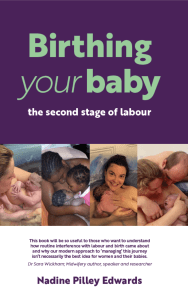
Meeting her baby for the very first time, is usually one of the most powerful and magical experiences of a woman’s life. If surrounded by love, privacy and calmness, her body takes over and instinctively knows how to birth her baby, even if she hasn’t had a baby before. While obstetric expertise and technology are invaluable for the mothers and babies who need them, too often, routine practices and interventions can make it more difficult for women to birth their babies straight forwardly using their own strengths and instincts. This book describes physiological birthing, looks at current beliefs and practices around birthing, examines some of the relevant research and suggests how women can increase the likelihood of giving birth to their babies using their own efforts without unnecessary interventions.
Birthing Your Placenta: the third stage of labour

Have you ever thought about how the placenta is born? Did you know that there are actually three different approaches to the birth of the placenta within maternity care? Are you aware that research has shown significant advantages to the baby in taking a slower approach, however the placenta is born. Or that there is plenty of evidence to support a more natural approach for healthy women who would prefer that?This book has been written to help women make decisions about the birth of their placenta. We examine the different options, detail the evidence relating to each and discuss the wider context in which these decisions are made. No matter what kind of birth you are hoping for, this book will help you understand the different options.Dr Nadine Edwards and Dr Sara Wickham are world renowned and respected researchers and writers who have a long-standing interest in the birth of the placenta and the evidence relating to this. This is a completely revised and updated edition of their popular book on this topic.
Untangling the Maternity Crisis

Arguing that contemporary maternity services provide a toxic environment both in which to practise and to give birth, this book looks at how we can change this. Its aim is promoting the best possible experiences of childbearing, and confident, strengthening and loving contexts for new parenthood.
Designed to create awareness about the professional and political realities which enmesh maternity care, this inspiring volume features an in-depth and research-oriented analysis of the challenges faced by contemporary maternity services. Recognising the frequently hostile environment in which midwives practise, the contributors go on to explore its impact on women and families, as well as on midwives themselves. They then look at woman-centred and community-based ways of contributing to a much better birthing experience for all.
Important and relevant for all those with an interest in improving maternity care, this book is particularly suited to midwives – practising and student, doulas, birth educators and activists, policymakers and health service managers.
Birthing Autonomy: Women’s Experiences of Planning Home Births

Nadine Edwards provides an in-depth exploration of how women make decisions about home births and what aspects matter most to them. Comparing how differently the pros and cons of home births are constructed and contemplated by mothers and by the medical profession, the book looks at how current obstetric thinking and practices can disempower and harm women emotionally and spiritually as well as physically.
PhD Thesis
Nadine’s book, Birthing Autonomy: Women’s Experiences of Planning Home Births, based on her PhD thesis, Women’s experiences of planning home births in Scotland: birthing autonomy, University of Sheffield, which is available, in full, for free download here: http://etheses.whiterose.ac.uk/12829/
Abstract
The general aim of this study was to provide an in-depth exploration of the experiences of a group of 30 women who planned home births. This was to expand on the small amount of qualitative research in the field and suggest avenues for further research. With this general aim, I analysed the women’s experiences in relation to the contexts in which they planned home births in order to provide a useful account for the women in the study, those who may plan home births in the future, as well as clinicians, managers and policy-makers involved in maternity services. I considered some of the wider political, social and historical discourses, which underpin the present situation in Scotland regarding home births. While I acknowledged that these are unstable reference points, they were useful in gaining insights into the current situation. This was particularly the case when looking at home birth as part of a complex interplay between dominant and subordinate ideologies, which were partially played out through gender relations symbolised by the male doctor and the female midwife. A postmodern reading of feminisms provided the conceptual tools to examine diverse belief systems around birth in relation to women’s narratives. Suspending “truth” enabled diverse knowledges to become more visible. This validated women’s experiential knowledge which could then be placed alongside other knowledge systems, and examined in terms of dominant and marginalised ideologies. The project became one of conflicts and silences, searching out and listening to, and making visible “other” voices. This raised issues of power, control, autonomy and resistance. In most cases I interviewed each woman twice before her baby’s birth and twice following the birth. Interviews were usually 1 to 2 hours in length, taped and transcribed. A qualitative software program, NUD*IST was used to assist with analysis, but the conceptual framework for the analysis remained rooted in a postmodern feminist approach using a relational voice methodology. The main findings were that National Health Service (NHS) community midwifery services were based on an attenuated technocratic model of birth. This imposed a philosophy and structure of care that prevented women and midwives from developing alternative ideologies based on their own knowledge. It prevented women and midwives from forming trusting, supportive relationships, which stand at the core of holistic philosophies of birth. Women and midwives were often obliged to draw on subversive techniques to use their knowledge and skills in order to make the best of a system which by definition could not be woman-centred or holistic. The main conclusion was that birth requires to be socialised rather than medicalised, so that technology and medical practices can be developed and used to support women and babies, and midwifery practices when necessary, rather than birth being technocratised and social practices used to humanise an essentially inhumane system of care.